
ACS Statutory Declaration Service: Employment Evidence Requirements & Documentation Guide
ACS Statutory Declaration Service: Employment Evidence Requirements & Documentation Guide
Providing correct employment evidence is an essential step in the ACS Migration Skills Assessment process. An applicant must prove their IT work experience is real, related to the nominated occupation, and properly documented.
However, getting an employment reference letter is not always easy. An employer may be inactive, unresponsive, or reluctant to issue an extensive employment reference letter. In other cases, applicants may not have any employers but operate independently.
In these cases, a statutory declaration can help prove relevant work experience. The applicant must also meet certain ACS document requirements.
In this guide, you will learn about the ACS statutory declaration service. You will also learn who can prepare it and what ACS work experience verification you must include.
Understanding the ACS Statutory Declaration Service
A statutory declaration is a written statement used as evidence. It gives employment details when you cannot get a reference letter.
It is a legal declaration signed in front of an authorized witness. The person issuing the statutory declaration attests that the information provided is true.
For ACS Migration Skills Assessment, an ACS statutory declaration form or an affidavit can be useful to establish the following information:
- The applicant’s employment history and the relevant dates.
- The applicant’s professional position and responsibilities.
- The nature of the working relationship between the applicant and his/her employer.
- The duties performed during the relevant employment period.
- Reasons for the inability to obtain a standard employment reference letter.
However, a statutory declaration is not necessarily accepted as an alternative to an employment reference. ACS has specific eligibility criteria, content requirements, and additional documentation requirements that the applicant must satisfy.
When Do You Need an ACS Statutory Declaration?
Usually, ACS requires providing an employment reference for each relevant employment period. A statutory declaration or an affidavit may be accepted in specific cases when it is impossible to get the standard reference.
1. Unable to Obtain an Employment Reference
You may need an ACS statutory declaration in cases where your previous employer:
- No longer exists.
- Is not reachable.
- Refuses to provide the employment reference.
- Is not able to provide the relevant employment details.
- Cannot verify your responsibilities in its regular records.
Importantly, ACS requires a letter or official e-mail from the company explaining the reasons for the inability to provide an employment reference.
The statutory declaration must be provided by a former work colleague holding the position of a manager or a supervisor who worked with the applicant in question.
2. Self-Employment
Applicants operating independently, as contractors, or being self-employed may have to submit a self-written statutory declaration.
Unlike statutory declarations written by former colleagues, self-written statutory declarations are prepared by the applicant himself/herself.
Those documents should contain the following information:
- The dates of self-employment beginning and end.
- The applicant’s occupation and employment arrangement.
- The nature of the business operated and services provided.
- Responsibilities and activities performed.
- Number of employees (if any), their occupations, and positions.
A self-written statutory declaration must also be supported by relevant documentation.
Who Can Write an ACS Statutory Declaration?
One of the most important ACS statutory declaration requirements relates to the person preparing the document.
The regulations are different depending on whether the applicant was employed by some organization or operated independently.
For Previously Employed Applicants
If it is impossible to obtain an employment reference, the statutory declaration must be prepared by a former work colleague who:
- Holds the position of a manager or a supervisor.
- Has worked at the same company as the applicant.
- Had overlapping employment period with the applicant.
- Was familiar with the applicant’s day-to-day responsibilities.
- Could describe the working relationship and responsibilities accurately.
The declarant should not be a junior colleague or a former co-worker agreeing with the applicant’s description of the employment.
For instance, a former IT manager directly supervising the applicant during the relevant period may serve as an adequate declarant.
For Self-Employed Applicants
Applicants operating independently must provide their own statutory declaration.
Such a document should contain a clear description of the business activities and professional responsibilities performed.
It should also be supported by relevant documentation.
ACS Statutory Declaration Form: What Information Must Be Included?
Applicants looking for an ACS statutory declaration form should know that the satisfaction of the content and witnessing requirements is more important than the document’s appearance.
For an employee, ACS provides a list of information items that should be covered in the declaration.
| Required information | What to include |
|---|---|
| Employer details | Company name, address and website |
| Applicant details | Full legal name |
| Declaration date | Date the document was prepared |
| Employment dates | The precise start and end dates in DD/MM/YYYY format |
| Employment status | Full-time, part-time or contractor |
| Working hours | Minimum hours worked per week |
| Salary | Annual salary before tax and applicable benefits |
| Work location | Australia or Outside Australia |
| Position title | Official job title or designation |
| Employment duties | Specific responsibilities performed |
| Declarant details | Full name, position title and contact information |
If the applicant performed several jobs in the same company, each job position should have its own employment dates and duties performed.
Witnessing and Signature Requirements
The document must include the text attesting that the declaration:
- Has been sworn before;
- Has been signed before;
- Has been witnessed before an authorized witness.
The declarant should sign the document in front of the authorized witness. The witness’s signature, the date of signing, and the location must also be provided.
Witnessing should be done properly. A stamp testifying only to the fact that the document is an attested copy does not satisfy this requirement.
Details of the Working Relationship
The statutory declaration should contain information about how the declarant knew the applicant professionally and was able to verify his/her duties.
For instance, the declarant could say that he/she was a direct supervisor of the applicant, interacted with him/her regularly, and saw his/her professional responsibilities throughout the whole period of employment.
This information is necessary for ACS to be sure that the person providing the statutory declaration has real knowledge of the relevant employment period.
Supporting Documents for an ACS Statutory Declaration Service
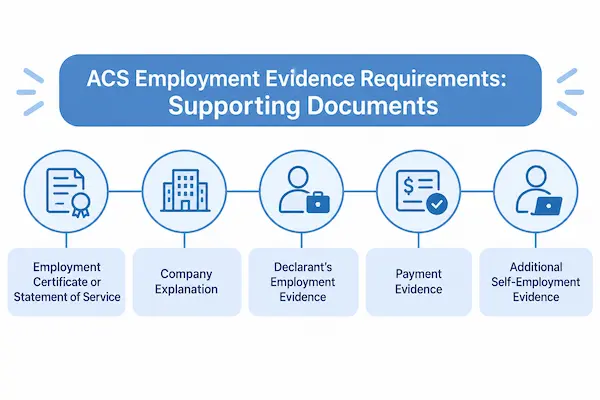
Submission of a statutory declaration is only one of the steps in providing employment evidence. Applicable applicants have to submit additional documentation to support their claims.
1. Employment Certificate or Statement of Service
An applicant submitting the statutory declaration provided by a work colleague must provide an Employment Certificate or Statement of Service from the employer.
The documents should be issued on the official company letterhead and should cover the relevant dates of employment.
If the applicant has already left the company, a leaving certificate containing the commencement and completion dates can be submitted.
2. Company Explanation
If the employment reference cannot be obtained, an applicant must provide the official letter or e-mail explaining the reasons.
This will help ACS to understand why alternative employment evidence is being provided.
3. Declarant’s Employment Evidence
The applicant’s declarant must provide his/her own employment evidence to confirm the working relationship with the applicant.
ACS requires at least one of the following documents:
- An Employment Certificate or Statement of Service issued on the official company letterhead and proving the declarant’s starting date.
- A leaving certificate issued on the official company letterhead and proving the declarant’s starting and ending dates.
The declarant’s employment period must intersect with the applicant’s relevant employment period.
4. Payment Evidence
The applicant must also provide payment evidence proving that the relevant employment was paid.
Depending on the situation, the applicant may have to provide one of the following:
- Payslips.
- Bank statements containing salary deposits.
- Taxation records.
- Any other relevant documents.
The payment evidence should correspond to the applicant’s relevant employment period.
5. Additional Self-Employment Evidence
Applicants who provide a statutory declaration about self-employment experience must provide additional evidence proving their business activities and professional duties.
It includes:
- Business registration certificates for the whole period of self-employment.
- The statement of the accountant or legal representative attesting the business name, the nature of the business, the applicant’s role, and the period of self-employment.
- Statements of the clients describing the services provided, dates, and minimum working hours per week.
- Client invoices accompanied by the bank statements.
- Taxation records.
- Relevant contracts with clients and suppliers.
These documents help to prove that the applicant was really running his/her own business and doing the claimed professional work.
ACS Work Experience Verification: How Does ACS Assess a Statutory Declaration?
Providing a statutory declaration does not mean that the claimed employment experience will automatically be recognized as adequate.
ACS examines the employment evidence in order to assess whether the relevant employment experience is applicable to the applicant’s profession and occupation.
1. Verification of Employment History
ACS checks the employment dates, employer’s information, position title, and supporting documents in order to be sure that the relevant employment is real.
The employer and the declarant can also undergo verification checks.
2. Assessment of Professional Duties
Duties mentioned in the statutory declaration must properly reflect the professional responsibilities of the applicant.
ACS assesses whether the duties are relevant to the nominated occupation and whether they were performed by the applicant at the proper professional level.
Listing of general IT activities may be insufficient to prove the duties and responsibilities of the applicant.
3. Verification of Paid Employment
ACS also considers the evidence of payment in order to assess whether the employment was paid and whether the salary was commensurate with the applicant’s skill level.
4. Assessment of Supporting Documents
ACS considers a statutory declaration together with the employment certificate, payment records, and other supporting evidence.
The acceptance is dependent on the ACS verification and the assessment discretion. Therefore, a statutory declaration must be proper and supported by the necessary evidence.
Common Mistakes to Avoid When Preparing an ACS Statutory Declaration
An improperly prepared statutory declaration can lead to the conclusion that the claimed employment experience is unsuitable.
The following are the common mistakes applicants should avoid.
1. Preparing the document themselves when a declaration by a colleague is required
In case when an applicant cannot obtain an employment reference letter, ACS requires providing the declaration by a former manager or a supervisor. A self-written declaration will not be accepted in this situation.
2. Choosing an inadequate declarant
The junior work colleague or the person who was not familiar with the applicant’s professional responsibilities may not be an adequate declarant.
3. Omitting witnessing details
The document must state that it was sworn, signed, or witnessed before an authorized witness. It must also include the signatures of both the declarant and the witness, the signing date, and the place.
4. Providing inconsistent employment dates
Employment dates must coincide with those contained in the employment certificate and other supporting documents. The inconsistencies may raise some doubts.
5. Copying duties from ANZSCO descriptions
Duties mentioned in the declaration must contain information about the duties performed by the applicant. Copying the duties from ANZSCO or other sources is unacceptable.
6. Providing insufficient supporting documents
The statutory declaration must not be used as a substitute for all the other documents required to prove employment. The applicant must also provide the necessary supporting evidence.
7. Altering the document after witnessing
After the document has been witnessed, it cannot be changed anymore. In case of any changes, the document must be prepared and witnessed anew.
How to Prepare Your ACS Statutory Declaration: A Step-by-Step Guide
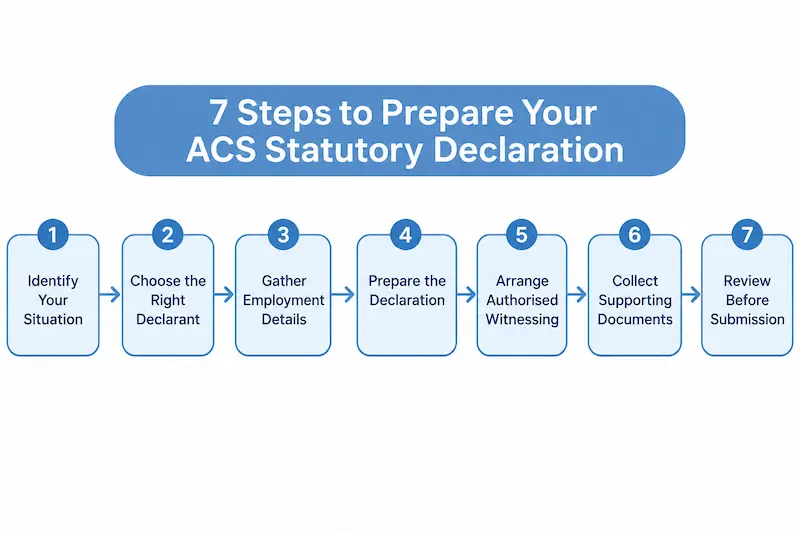
Preparing your documentation in advance can make the process more organised and reduce the risk of missing information.
Step 1: Determine the Reason for Providing a Statutory Declaration
Decide whether you cannot obtain a standard employment reference letter or whether you are claiming self-employment experience.
Step 2: Find a Proper Declarant
If you worked in a company, find a former manager or supervisor familiar with your responsibilities. If you worked independently, prepare your own statutory declaration.
Step 3: Collect Employment Information
Collect the information about your employment dates, position titles, working hours, salary, employer information, and duties performed.
Step 4: Prepare the Document
Prepare the document according to the applicable ACS requirements. Make sure that duties and employment information are consistent with the supporting evidence.
Step 5: Arrange the Witnessing
Sign the document in front of an authorized witness. If the declaration is being made abroad, consult the Australian Embassy or the relevant legislation of the country in which the document is being signed.
Step 6: Collect Supporting Evidence
Collect the employment certificates, company correspondence, declarant employment evidence, and payment records. Also, collect the relevant documentation about self-employment for self-employed applicants.
Step 7: Review the Complete Set of Documents
Review all the dates, signatures, contact information, and supporting records before submitting the documents via the ACS application portal.
Conclusion
An ACS statutory declaration may be helpful for those applicants who cannot obtain an employment reference letter or need to prove self-employment experience. However, ACS has specific requirements for the person making a statutory declaration. It also lists what information to include and what supporting documents are needed.
Understanding the ACS employment evidence requirements ahead of the submission will help applicants to prepare their application better.
No matter what you need, make sure all details match the applicant’s real work history.
You may need a statutory declaration from a former colleague or you may need proof of self-employment.
Frequently Asked Questions
1. Is there a statutory declaration form provided by ACS?
ACS specifies the required content and witnessing of the statement. It would be better to use the official guideline, rather than using any template for a statutory declaration.
2. May I make my own statutory declaration about my previous employment?
No. You have to prepare your own statutory declaration only if you cannot receive an employment reference.
3. My previous employer no longer exists. How do I explain this and what documentation should I provide?
You have to provide official evidence about the reason why you cannot get an employment reference, as well as the statutory declaration from a colleague and relevant supporting documents.
4. Should I submit any supporting documents with the statutory declaration?
Yes. The type of supporting documents will depend on your situation and might include employment certificates, an explanation of the company, evidence and payment of the declarant.
5. Can self-employed applicants submit a statutory declaration?
Yes. In such a case, the applicant has to provide the statutory declaration, prepared by himself/herself, as well as relevant documentation, including business registration, client statements, etc.
6. Does ACS accept my statutory declaration?
No. The acceptance of the declaration is dependent on ACS verification and its assessment criteria.
7. Is it acceptable to sign the statutory declaration outside Australia?
Yes. There are some special requirements concerning witnessing of such a declaration. ACS recommends contacting an Australian Embassy or the official requirements of the country.